

The Okadaic Acid (DSP) ELISA Kit (EL2050-01) is a competitive okadaic acid ELISA kit for the quantitative analysis of okadaic acid in water, food, shellfish, wastewater and other environmental samples. It runs in a 96-well plate format with six standards from 0 to 16.2 ppb, an overall sensitivity of 0.3 ppb, and a 0.6 ppb detection limit in water, wastewater and culture media. Incubation takes 45 minutes in total.
Okadaic acid (OA) is a potent marine toxin and protein phosphatase inhibitor produced by dinoflagellates of the genera Dinophysis and Prorocentrum. It accumulates in shellfish and is the causative agent of diarrhetic shellfish poisoning (DSP). DSP toxins are lipophilic polyether compounds, and shellfish contamination with OA has been associated with harmful algal blooms around the world.
Key Features
- Sensitivity: 0.3 ppb overall; detection limit 0.6 ppb in water, wastewater and culture media.
- Standard curve: okadaic acid standards at 0, 0.3, 0.9, 2.7, 5.4 and 16.2 ppb.
- Cross-reactivity: okadaic acid 100%, DTX-1 40%, DTX-2 20%, domoic acid and neosaxitoxin less than 1%.
- Sample types: water, wastewater, liquid media, shellfish and other food and environmental samples.
- Fast protocol: one 30-minute incubation and a 15-minute color development.
- Precision: CV less than 10%.
- Format and storage: 96-well plate of 12 strips × 8 wells; store at 2–8 °C, 12-month shelf life.
What’s in the Kit
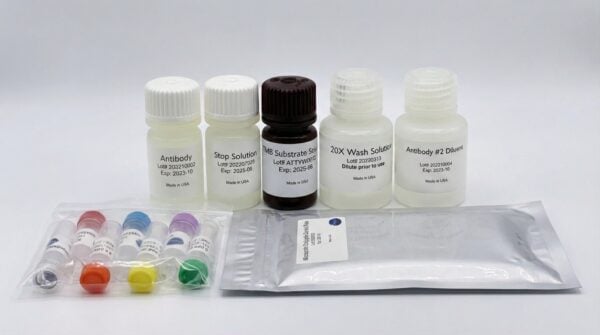
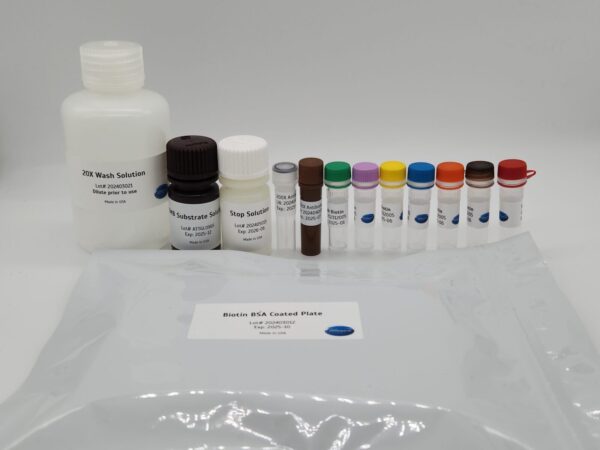
Each okadaic acid ELISA kit includes:
- Microtiter plate with 96 wells coated with second antibody
- Okadaic acid standards, 6 vials × 0.8 mL: 0, 0.3, 0.9, 2.7, 5.4 and 16.2 ppb
- Conjugated HRP, 6 mL
- Okadaic Acid Antibody, 6 mL
- 20X Wash Solution, 28 mL
- TMB Substrate Solution, 12 mL
- Stop Solution, 14 mL
- 10X Sample Extraction Buffer, 25 mL
You will also need: an ELISA plate reader (450 nm/630 nm), deionized water, methanol, a vortex mixer, a timer, a wash bottle, 50 mL and 2 mL polystyrene centrifuge tubes, and micropipettes covering 20–200 µL and 100–1000 µL. Shellfish extraction also calls for a homogenizer, a centrifuge and a way to heat extracts to 75 °C.
Who It’s For
The kit is intended for government and regulatory agencies, shellfish and food processors, quality assurance organizations, and researchers who monitor DSP toxins in shellfish, seawater and other environmental samples.
How to Use the Okadaic Acid ELISA Kit
Bring all reagents and microwells to room temperature for at least 30 minutes, and run standards and samples in duplicate.
- Prepare reagents: dilute 20X Wash Solution 1:20 and 10X Sample Extraction Buffer 1:10 with deionized water. Make 10% methanol from 9 volumes of 1X Sample Extraction Buffer and 1 volume of methanol.
- Prepare liquid samples: samples should be particle-free and at neutral pH. If needed, centrifuge at 4000 g for 5 minutes and use 50 µL of supernatant. Water samples can be diluted further in 10% methanol to fit the range.
- Prepare shellfish: homogenize the meat and extract 0.5 g with 2 mL of 50% methanol/water, vortexing 5 minutes. Centrifuge, heat 0.5 mL of supernatant at 75 °C for 5 minutes, and centrifuge again. Add 50 µL of supernatant to 950 µL of 10% methanol (dilution factor 1:100).
- Incubate: add 50 µL of standard, positive control or sample, 50 µL of Conjugated HRP and 50 µL of Okadaic Acid Antibody to each well. Shake 30 seconds, cover and incubate 30 minutes at room temperature.
- Wash: decant and rinse 3 times with 250 µL of 1X Wash Solution.
- Develop, stop and read: add 100 µL of TMB Substrate Solution and incubate 15 minutes at 25 °C, covered. Add 100 µL of Stop Solution and read at 450 nm within 5 minutes.
Full instructions are in the EL2050-01 kit manual (PDF).
How It Works and Reading Results
Free okadaic acid in the sample competes with HRP-labeled okadaic acid for the okadaic acid antibody, which is captured on the second-antibody-coated plate. More toxin in the sample means less bound enzyme and a lighter color.
Express each mean absorbance as a percentage of the zero standard (B/B0 × 100) and plot it against concentration on a semi-logarithmic scale. Read sample values from the curve and multiply by the dilution factor. Samples lighter than the 16.2 ppb standard should be diluted to fit the 0.3–16.2 ppb range and rerun.
Frequently Asked Questions
What does this okadaic acid ELISA kit detect?
It measures okadaic acid, with partial cross-reactivity to the related DSP toxins DTX-1 (40%) and DTX-2 (20%). Domoic acid and neosaxitoxin cross-react at less than 1%.
What regulatory levels apply to okadaic acid?
The EU has set a level of 160 ppb of OA or its equivalent. FDA guidance lists 0.16 mg/kg for clams, mussels, oysters, and whole and roe-on scallops; see FDA and EPA Safety Levels in Regulations and Guidance.
Can I test shellfish?
Yes. The manual includes a methanol extraction with a heating step for shellfish tissue, giving a final dilution factor of 1:100.
Is there a field test for okadaic acid?
Yes. The Okadaic Acid (DSP) Lateral Flow Kit is designed for field screening of fresh and seawater. Use the okadaic acid ELISA kit when you need quantitative lab results.
What other shellfish toxin ELISA kits are available?
Attogene also offers the Saxitoxin (PSP) ELISA Kit and the Brevetoxin ELISA Kit.
For research use only. Not for use in diagnostic procedures. Questions? Call 512-333-1330 or email sales@attogene.com.