

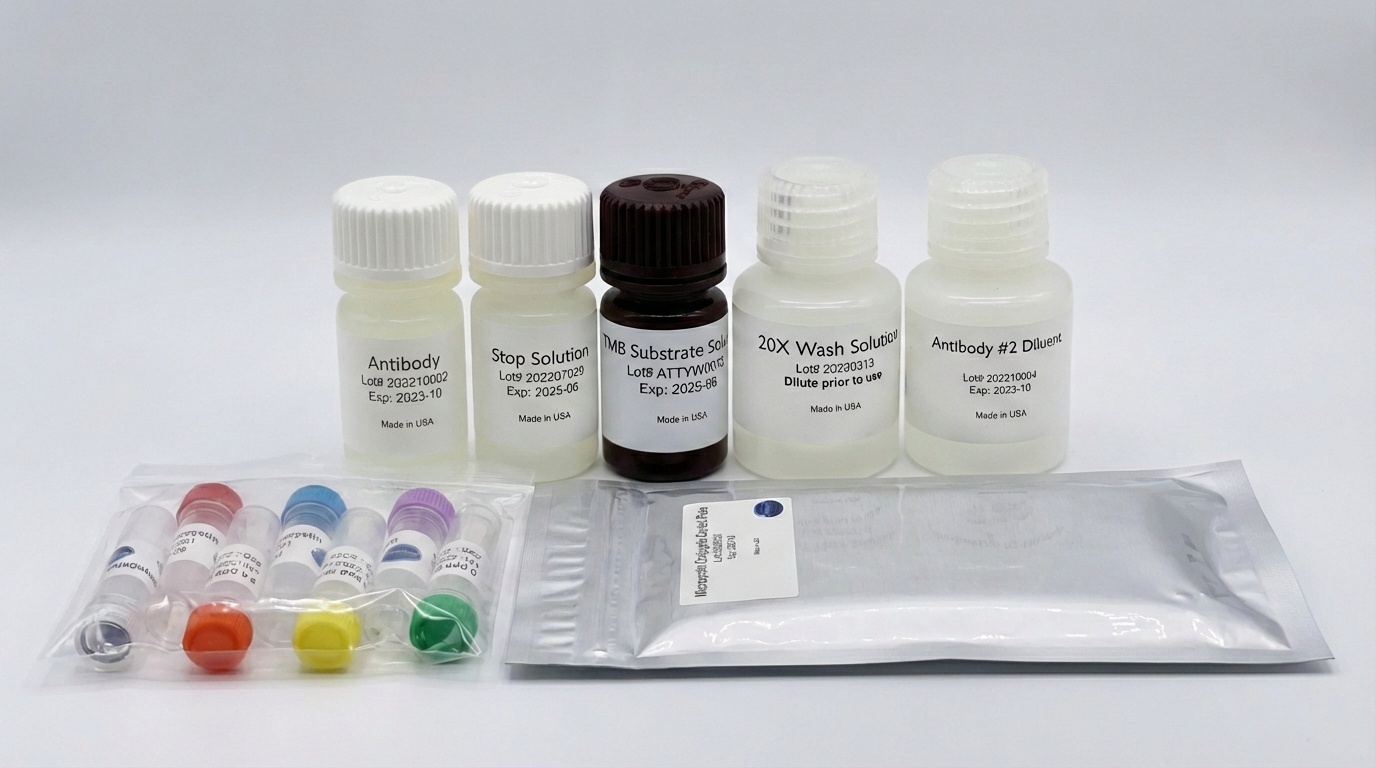
The Attogene Folic Acid ELISA Kit (catalog EL2020-01) is an indirect competitive folic acid ELISA kit for quantitative and qualitative analysis of folic acid in milk, milk powder and grain. Each kit contains a 96-well antigen-coated microtiter plate, six standards from 0 to 81 ppb and the reagents needed to run the assay and read it at 450 nm. Test sensitivity is 1 ppb, with a coefficient of variation (CV) below 10%.
Folic acid is the synthetic form of folate (vitamin B9) and is widely added to fortified flour, cereals and milk powders. This kit gives food labs a plate-based alternative to instrumental methods.
Key Features
- Indirect competitive format: sample folic acid competes with plate-coated antigen for antibody, so absorbance falls as concentration rises.
- Sensitivity: test sensitivity of 1 ppb, with detection limits of 10 ppb in milk and 100 ppb in milk powder and grain.
- Six-point standard curve: 0, 1, 3, 9, 27 and 81 ppb, plus a 10 ppb spiking standard solution.
- Short assay: one 30-minute incubation, a wash and a 15-minute substrate step, read at 450 nm.
What’s in the Kit
Each folic acid ELISA kit includes:
- Microtiter plate, 96 wells coated with antigen
- Standard solutions: 0, 1, 3, 9, 27 and 81 ppb (6 x 1 mL)
- Spiking standard solution, 10 ppb (1 mL)
- Enzyme conjugate (7 mL)
- Antibody solution (7 mL)
- Substrate solution A (7 mL) and solution B (7 mL)
- Stop solution (7 mL)
- 20X concentrated wash solution (40 mL)
- Concentrated extraction solution (50 mL)
Kit size is listed as 50 reactions on one 96-well plate; the manual recommends running all standards and samples in duplicate. Store the kit at 2–8 °C and do not freeze. Shelf life is 12 months.
You will also need: a microplate reader (450/630 nm), homogenizer or stomacher, shaker, vortex mixer, centrifuge, analytical balance (0.01 g), 10 mL graduated pipette, 100 mL and 500 mL volumetric flasks, 2 mL and 10 mL polystyrene tubes, micropipettes and a 250 µL multichannel pipette, sodium chloride and deionized water.
Who It’s For
- Dairy QC laboratories checking folic acid levels in milk and milk powder.
- Flour mills and grain processors verifying fortification in rice, maize, millet, soybean and flour.
- Nutrition researchers studying how processing affects folic acid content.
- Contract testing labs that want a plate-based screen before instrumental confirmation.
How to Use the Folic Acid ELISA Kit
The steps below summarize the protocol. Follow the full instructions in the Folic Acid ELISA kit manual (PDF).
- Prepare reagents. Make 2% NaCl (10 g sodium chloride made up to 500 mL with deionized water). Dilute the concentrated extraction solution 1:1 and the 20X wash solution 1:19 with deionized water.
- Prepare samples. Milk: mix 100 µL milk with 50 µL 2% NaCl and 850 µL diluted extraction solution, vortex 30 s and use 50 µL. Milk powder and grain: vortex 0.5 ± 0.05 g with 5 mL 2% NaCl for 2 min and let stand 5 min, then mix 100 µL of the supernatant with 900 µL extraction solution, vortex 30 s and use 50 µL.
- Equilibrate. Bring reagents and microwells to room temperature (20–25 °C) for at least 30 min and mix before use.
- Add standards, samples and reagents. Add 50 µL of standard or prepared sample, 50 µL of enzyme conjugate and 50 µL of antibody solution to each well. Shake gently and incubate 30 min at 25 °C, covered.
- Wash. Wash the wells 5–6 times with 250 µL diluted wash solution, then tap dry on absorbent paper.
- Develop color. Add 50 µL solution A and 50 µL solution B, shake gently and incubate 15 min at 25 °C, covered. Color development should never exceed 30 min.
- Stop and read. Add 50 µL stop solution and read absorbance at 450 nm, preferably 450/630 nm, within 5 min.
Reading Results and Assay Performance
Calculate percent absorbance for each standard and sample as B/B0 x 100, where B0 is the zero standard. Plot percent absorbance against the log of the standard concentration (ppb), read each sample from the curve and multiply by its dilution factor: 10 for milk and 100 for milk powder and grain.
- Test sensitivity: 1 ppb
- Detection limits: milk 10 ppb, milk powder 100 ppb, grain 100 ppb
- Accuracy: 90 ± 15% for milk, milk powder and grain
- Precision: CV less than 10%
- Cross-reactivity: folic acid 100%
If the zero standard reads below 0.5 absorbance units at 450 nm, the reagents may have deteriorated. The optimal reaction temperature is 25 °C; higher or lower temperatures change sensitivity and absorbance values.
Frequently Asked Questions
What samples can I test with the folic acid ELISA kit?
The manual covers milk, milk powder and grain, including rice, millet, maize, soybean and flour. Contact Attogene before testing other matrices.
How long does the assay take?
After sample preparation and a 30-minute reagent warm-up, the plate needs a 30-minute incubation, a wash and a 15-minute substrate step, then a reading within 5 minutes of stopping.
How should the kit and samples be stored?
Store the kit at 2–8 °C and do not freeze it; shelf life is 12 months. Keep untreated samples at 2–8 °C and assay treated samples immediately. Diluted extraction solution keeps for one month at 4 °C.
Can the folic acid ELISA kit be used on clinical samples?
No. The folic acid ELISA kit is for research use only and is not for use in diagnostic procedures. The manual covers food samples, not blood, serum or other clinical specimens.
Do you offer related vitamin assays?
Yes. See the vitamin B12 ELISA kit, the biotin ELISA kit and the Food Safety ELISA Kit Menu, or build your own assay with the ELISA do-it-yourself development starter kit.
For research use only. Not for use in diagnostic procedures. Questions? Call 512-333-1330 or email sales@attogene.com.


